Powering a Photo or Film Shoot on Location in Mallorca
Some of the best locations in Mallorca have one thing in common: there isn’t a plug socket anywhere nearby.
Beaches, mountain roads, fincas, rocky coves and remote countryside make Mallorca an excellent location for photography and film productions, but they can also make supplying power considerably more complicated.
Fortunately, location power has changed dramatically in recent years.
Where a generator was once the automatic choice, modern portable battery systems can now power surprisingly demanding equipment silently and without fuel. Generators still have an important role, but they’re no longer the only practical solution.
At Palma Equipment Rental, we supply portable battery power and generators for professional photo and video productions throughout Mallorca.
Here’s how to decide what you actually need.
Start With the Equipment, Not the Generator
Before deciding how to power a shoot, work out what actually needs electricity.
A typical production might include lighting, a digital capture station, monitors, laptops, battery chargers, hair and makeup equipment, steamers and various smaller accessories.
The important number is the combined power requirement.
A 1200W light doesn’t necessarily mean you only need a 1200W power source. If the same supply is also running a monitor, laptop, chargers and other equipment, the total requirement can quickly increase.
It is also worth separating equipment into groups.
Lighting may need substantial power for relatively short periods, while the digital station may require much less power but need to run continuously throughout the day.
Once you understand the load, choosing between battery power and a generator becomes much easier.
Battery Power Has Changed Location Shooting
Portable battery systems have become one of the biggest changes in location production.
For many shoots, it is now possible to take substantial mains-style power to a location without running a petrol generator.
That has several advantages.
There is no engine noise, no exhaust and no fuel to transport. Battery systems can be positioned close to the equipment being powered and can be particularly useful in locations where running long extension cables would be inconvenient.
They also start instantly.
For stills photography and smaller moving-image productions, this can make location setups significantly simpler.
Instagrid: High-Output Portable Power
One of the most useful location power options in our rental inventory is Instagrid.
The system can supply up to 3600W, making substantial power available in a portable battery unit.
For photography and film work, this creates some interesting possibilities.
High-output lighting, digital equipment and other production equipment can be operated in locations where mains electricity isn’t available, without automatically bringing a generator.
Instagrid is particularly useful when a production needs a relatively high amount of power but doesn’t need to run that maximum load continuously for an entire day.
It is also completely silent during operation.
That matters for moving-image productions recording sound, but it can also make a photographic set considerably more pleasant to work on.
EcoFlow for Flexible Location Power
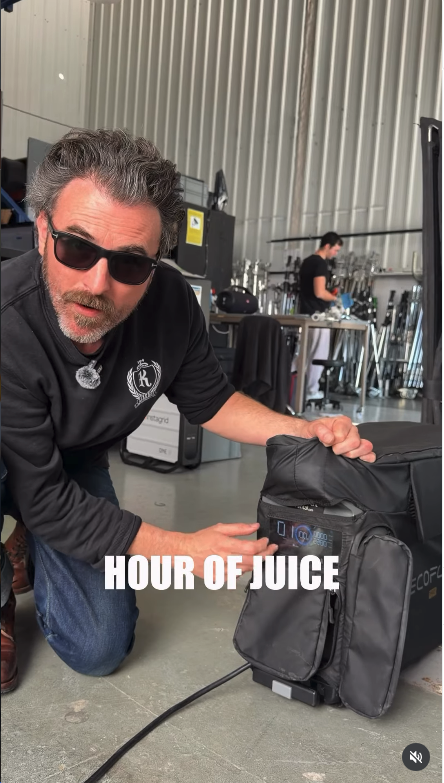
EcoFlow portable power stations offer another approach.
Palma Equipment Rental’s power inventory includes systems such as the EcoFlow DELTA Pro, DELTA 2 and RIVER Pro 600.
Different capacities allow the power system to be matched to the job.
A smaller unit can be useful for laptops, monitors, chargers and lower-powered equipment, while larger systems can support considerably more demanding setups.
EcoFlow is particularly useful for creating independent power stations around a location.
Instead of running one long cable from a central generator, the digital station might have its own battery supply while another unit powers equipment elsewhere.
For productions moving between several setups during the day, that flexibility can be extremely useful.
When a Generator Still Makes More Sense
Battery systems are excellent, but they haven’t made generators obsolete.
Sometimes a production simply needs a lot of power for a long time.
Large lighting packages, multiple high-consumption fixtures or equipment that must operate continuously can make a petrol generator the more practical choice.
Palma Equipment Rental supplies Honda generators, including compact options and larger systems for more demanding loads.
The advantage of a generator is straightforward: as long as you can safely keep supplying fuel, it can continue producing electricity.
For a long shooting day with sustained high power consumption, that can be more practical than trying to carry enough battery capacity for the entire production.
Generator Noise Matters
Power isn’t the only consideration.
Generators make noise.
On a stills shoot, this may simply be an inconvenience. On a film or video production recording sync sound, it can become a serious problem.
The generator may need to be positioned a significant distance from the shooting area, which means planning appropriate extension cables and power distribution.
The location itself matters too.
A generator hidden around a building may be relatively easy to isolate acoustically. On an exposed beach or quiet countryside location, there may be nowhere useful to put it.
This is one reason silent battery power can be so valuable for moving-image work.
Powering High-Output LED Lighting
Modern LED lighting is much more efficient than older lighting technologies, but high-output fixtures still require serious power.
Fixtures such as the Aputure 700X, Aputure 1200D and Nanlux Evoke 2400B allow productions to put substantial continuous light onto exterior locations.
That output comes with a corresponding electrical requirement.
When several large fixtures are being used simultaneously, the total load needs to be calculated rather than considering each light individually.
It is also important to leave sensible headroom rather than planning a system that operates permanently at its absolute maximum.
A power system that works perfectly with one large lamp may not be suitable once a second fixture, digital station and collection of chargers are connected.
Don’t Forget the Digital Station
The biggest light on the equipment list usually gets all the attention.
Meanwhile, the digital station quietly needs electricity for the entire day.
A professional tethered photography setup might include a MacBook Pro, EIZO monitor, external SSDs, camera batteries, radios, phones and other devices requiring charging.
Individually, none may represent a huge load.
Collectively, and over a ten-hour shooting day, they matter.
Giving the digital station its own smaller portable power supply can often be more efficient than connecting it to the main lighting power system.
It also means the photographer’s workflow isn’t interrupted every time the lighting department changes setup.
Think About Where the Power Needs to Go
Producing electricity is only half the problem.
You also need to get it safely to the equipment.
Extension cables, Schuko connections and distribution strips are an essential part of the power package.
Before the shoot, consider how far the power source will be from the equipment and whether different departments need independent supplies.
A single power source with cables running in several directions may work perfectly in one location and become completely impractical in another.
On a busy set, cable routing also becomes a safety issue.
The fewer unnecessary cables crossing working areas, the better.
Remote Mallorca Locations
Mallorca can be deceptive when planning logistics.
A location may look easily accessible on a map while the actual shooting position is several hundred metres from the nearest place a vehicle can stop.
That’s a significant consideration when the equipment includes generators, large battery systems, lighting and grip.
Portable power can be particularly valuable in these situations.
A battery unit that can be transported with the lighting equipment may make much more sense than positioning a generator near the vehicle and running a long cable to the set.
Before choosing the power system, it’s worth asking a very simple question:
How does the electricity physically get from the van to where we’re shooting?
Power for Beaches and Coastal Locations
Beaches create their own challenges.
Sand, salt water and electrical equipment aren’t natural friends.
Power systems should be positioned somewhere stable and protected, with connections kept away from water and unnecessary exposure to sand.
Cable routes also need careful thought where crew, talent or members of the public may be walking.
If the shoot is moving frequently along the coastline, a compact battery solution can be considerably easier than repeatedly relocating a conventional generator setup.
Don’t Plan to the Absolute Limit
If your calculated requirement is 3,500W, choosing a 3,600W supply doesn’t necessarily mean you have designed a good power system.
Real productions change.
Someone plugs in another charger. Hair and makeup need something unexpectedly. Another fixture gets added. A piece of equipment behaves differently from its simple headline power rating.
Building some headroom into the system makes the entire setup more robust.
If the calculated load is already close to the maximum output of the power source, it is worth considering a larger supply or dividing the load between multiple systems.
Battery or Generator?
There isn’t a universal answer.
For a small photography setup, a compact EcoFlow may be all that’s required.
For a mobile fashion shoot with substantial lighting, Instagrid can provide high-output silent power without the logistics of a generator.
For a digital capture station, a separate portable battery can provide quiet continuous power throughout the day.
For a large production running multiple high-output fixtures for long periods, a Honda generator may still be the most practical solution.
And for some shoots, the best solution is a combination: generator power for the main lighting package and battery systems for digital, remote fixtures or setups away from the main unit.
The right choice depends on how much power you need, how long you need it and where you need to take it.
Location Power Rental in Mallorca
Palma Equipment Rental supplies professional location power equipment for photography and film productions throughout Mallorca, including Instagrid, EcoFlow portable power stations and Honda generators.
We can also supply the cables, power distribution and supporting equipment needed to turn the power source into a practical location setup.
Our rental facility is based in Palma de Mallorca, with equipment available for productions across Mallorca and the other Balearic Islands. Mainland Spain can also be arranged on request.
If you’re unsure what power system you need, send us your equipment list.
We can look at what you’re planning to run, where you’re shooting and how long the equipment needs to operate, and help work out a practical solution.
Because on location, having enough power is important.
Getting that power to where you actually need it is just as important.